
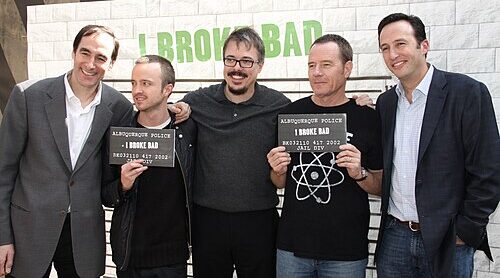
Before Breaking Bad: New Mexico on Film
How New Mexico went from a legendary movie location to a major production center, and the tiny independent film made during that transition.
Today, New Mexico is inseparable from images of Albuquerque, Breaking Bad, Better Call Saul, and a thriving film and television industry. But New Mexico's relationship with filmmaking began more than a century before Walter White ever stepped into an Albuquerque car wash.
I came to New Mexico as an independent filmmaker during a very different moment. I made Lost in New Mexico on a tiny budget, at a time when the state was beginning to transform itself from a place where Hollywood came to shoot into a place that actively competed for film production. Looking back now, I can see I was working right at the hinge point of that transition, though I did not know it at the time.
New Mexico Was a Movie Location Long Before Breaking Bad
New Mexico's relationship with the movies is almost as old as the movies themselves. In 1898, Thomas Edison and a film crew traveled by train to Isleta Pueblo, just south of Albuquerque, and shot a fifty-second actuality called Indian Day School. It shows a line of Native American children filing in and out of a one-room schoolhouse, and it is generally regarded as the first film shot on location in New Mexico Territory, more than a decade before statehood.
The territory did not stay a novelty for long. By the early and mid-1910s, the Selig Polyscope Company had set up something close to a working studio in Las Vegas, New Mexico, and its biggest star, Tom Mix, made dozens of short Westerns there, contemporary reports put the count at twenty to thirty films in a single year. Mix did his own stunts, cultivated a six-shooter-and-a-grin persona that would define the American cowboy on screen for decades, and helped set a template other filmmakers kept returning to: New Mexico as the visual language of the frontier.
That association held for most of the twentieth century. Billy the Kid became something like a house genre unto himself. A 1911 silent version was the first of more than seventy films eventually made about the outlaw, and a 1930 version directed by King Vidor was shot around Gallup. Through the 1940s and 1950s, films like The Grapes of Wrath (1940) and Ace in the Hole (1951), both filmed around Gallup, kept the state's mesas and small towns in front of national audiences.
For decades, the image of New Mexico onscreen was largely the image of the American frontier: horses, dusty roads, ranches, deserts, mountains, and small towns. The state had become part of Hollywood's visual language long before it became part of Hollywood's production infrastructure.
Why Did Filmmakers Come to New Mexico?
Ask anyone who has scouted locations in New Mexico and the first answer is geography. Within a relatively short drive, a filmmaker can find desert, mountains, plains, forest, ranch country, pueblo architecture, and Spanish colonial towns. That range gave New Mexico an unusual ability to stand in for other places entirely, without a production ever leaving the state.
The second answer is light. The Southwest offers the kind of intense sun, dry air, and open sky that photographs distinctively, the look that makes a Western feel like a Western before a horse ever enters the frame. Cinematographers have chased that light in New Mexico since Tom Mix's era.
But scenery alone does not build a film industry. A state can be a spectacular place to shoot while capturing very little of the money a production actually spends: crew payroll, equipment rentals, hotel rooms, catering, lumber and hardware for sets. For most of the twentieth century, New Mexico was mainly living on the first model, productions arrived, shot the landscape, and left. The important change came when the state started trying to keep more of that spending at home.
From Film Location to Film Industry
There is a real difference between being a place where a movie is filmed and being a place where movies are made. In the first model, a production flies in, shoots its exteriors, and flies back out, taking most of its budget with it. In the second, productions hire local crews, rent local equipment, use local facilities, and put money into an ecosystem that survives after that particular production wraps.
New Mexico spent the final decades of the twentieth century inching toward the second model. Silverado (1985), Young Guns (1988), and The Milagro Beanfield War (1988), the last shot largely in the village of Truchas, kept the state working steadily through the 1980s, and Terminator 2: Judgment Day used Santa Fe locations in 1991. Governors Bruce King, Gary Johnson, and Bill Richardson are all credited with helping build the political groundwork that eventually turned that steady work into a deliberate industrial strategy, one built around tax incentives.
The Early Incentive Years
New Mexico's film incentive is written directly into state law as the Film Production Tax Credit Act, and its legislative history is public record. The Legislature created the original credit in 2002, through Laws 2002, Chapter 36, Section 1, codified as NMSA 1978 Section 7-2F-1, at an initial rate of fifteen percent of qualified direct production expenditures made in the state. The following year, Laws 2003, Chapter 127 added the Act's definitions section and rounded the law into the form that would govern the program for its first several years. That made New Mexico one of the first states in the country to compete for Hollywood productions with a tax incentive rather than scenery alone, years ahead of the wave of state incentive programs that followed over the next decade.
For an independent filmmaker, an incentive is not an abstract line in an economic development report. It can be the difference between a production happening and a production staying on paper. A rebate on production spending turns part of the budget back into usable resources, whether that means an extra shooting day, a better camera package, or simply enough cash flow to get through post-production.
The state's ambitions went beyond luring any single movie. Every production that came through, however small, added to a pool of experienced crew, equipment vendors, and local production companies, the kind of infrastructure that makes the next production easier to bring in. That compounding effect is the whole logic behind an incentive program, and it is also, as it turned out, the environment my own film landed in.
Lost in New Mexico: The Pivot Year
My own experience of that transition came through Lost in New Mexico, released under its original title Susan Hero, a project I wrote, produced, and directed through Camerado between 2003 and 2004, in the earliest years of the state's new incentive program. It is a multicultural, science-fiction road movie: a woman named Susan, desperate to clone her deceased daughter, sets out across the Southwest with her undocumented companion, Javier Apollinaire, in search of a maverick animal-cloning expert who claims he can bring the child back. The film premiered on the festival circuit in 2007 and reached wider release in 2009.
It was not a major Hollywood production. The budget was tiny by industry standards, *, and I received a rebate under the state's incentive program during its infancy. Looking back, that is one of the more interesting things about it. I was participating in a state strategy that was helping change New Mexico's relationship with film production, even though at the time I was simply trying to get my own movie made.
I chose New Mexico partly because it was familiar ground. I had lived in the state before, and returning to shoot there put me back in a place I already understood. * The production moved through Albuquerque, Laguna Pueblo, and Mountainair, a spread that let a very small crew access desert, pueblo, and small-town settings without traveling far between them, and the incentive environment made the economics workable for a production of our scale.
This was filmmaking at a very different scale from the productions that would later make New Mexico internationally famous. We were working with *, moving between those three locations and solving the kind of problems that come with making a feature on a very limited budget.
What It Was Actually Like to Make an Ultra-Low Budget Movie in New Mexico in the early 2000's?
One advantage of shooting in New Mexico was that extraordinary landscapes were not something the production had to manufacture. Albuquerque's urban edges, Laguna Pueblo's open country, and Mountainair's small-town streets were simply there, available with a drive rather than a construction budget.
Our actual experience was...
One day, we...
For a production our size, the incentive was not theoretical. It affected the actual economics of the film and helped make the production possible in the first place.
Watch Now
Then the Industry Started Getting Bigger
The productions coming into New Mexico did not stay small. In 2007 alone, roughly thirty films were produced in the state, generating an estimated 253 million dollars in production spending and supporting thousands of jobs, direct and indirect. As more work arrived, the state accumulated something difficult to build from scratch: experienced crews, equipment houses, production companies, and institutional knowledge of how to actually get a film made there.
That creates a feedback loop. More productions train more experienced crew members. A deeper crew base makes the state more attractive to the next production. More productions create demand for better facilities and infrastructure. By the middle of the 2000s, New Mexico was drawing a steady stream of studio productions. No Country for Old Men, 3:10 to Yuma, and Wild Hogs all shot there in 2007 alone, and the pieces for something bigger were already in place.
1898, Edison at Isleta Pueblo → 1910s, Tom Mix and the Western era → 1985 to 1991, Silverado to Terminator 2 → 2002, the incentive program is created → 2003 to 2004, Lost in New Mexico is produced → 2007, the credit rises to 25 percent and studio productions surge → 2008, Breaking Bad
Then Came Breaking Bad
By the time Breaking Bad premiered on AMC in January 2008, New Mexico was no longer simply a beautiful place for Hollywood to shoot. It had spent five years building the incentive structure, and much longer than that building the location experience, needed to support a production of that scale and duration.
Breaking Bad changed how millions of viewers saw the state. Albuquerque stopped being a generic backdrop for a story set somewhere in the Southwest and became an internationally recognizable location in its own right, distinctive enough that the show spawned guided tours of its filming locations while it was still on the air.
But the timing matters. Breaking Bad did not create New Mexico's film industry out of nothing. It arrived after more than a century of location filmmaking and five years of incentive-driven infrastructure building, and it is better understood as the payoff of that groundwork than as its starting point.
New Mexico After Breaking Bad
The success of Breaking Bad, which ran through 2013, was followed by an expanding list of major productions, including its spinoff Better Call Saul (2015 to 2022) and the film El Camino: A Breaking Bad Movie (2019), while the state kept developing its studios, crews, and incentive terms.
The clearest sign of how far the industry had come arrived in 2018, when Netflix bought Albuquerque Studios outright, its first-ever purchase of a physical studio complex, and committed to a billion dollars in New Mexico production spending over the following decade. In 2019, NBCUniversal followed with its own roughly 500 million dollar studio commitment in Albuquerque. By 2020, Netflix had expanded its New Mexico campus with a second billion-dollar pledge, turning the property into one of the largest production facilities in North America.
New Mexico's incentive program grew alongside these deals. The original 2002 credit was raised to twenty-five percent by a 2007 amendment, and the Legislature has revised the Act repeatedly since, including a 2023 law that doubled the rural filming bonus from five to ten percent. As of fiscal year 2026, the program offers a twenty-five percent base credit on qualified in-state spending, stackable with a ten percent uplift for productions filming at least sixty miles outside the Albuquerque and Santa Fe city halls, a five percent bonus for television pilots or series, and a five percent bonus for shooting at a state-designated Qualified Production Facility, for a combined ceiling of forty percent. The annual funding cap sits at 140 million dollars for fiscal year 2026, scheduled to rise to 150 million in fiscal year 2027 and 160 million in fiscal year 2028 and beyond, with no per-project cap and no minimum spending requirement. The original 2002 statute was itself formally repealed and consolidated into a newer version of the Act effective July 1, 2025, which shows how often the Legislature keeps returning to adjust it.
The result is the New Mexico that filmmakers encounter today: not simply a spectacular location, but an established production environment capable of supporting projects at very different scales, from Netflix's Stranger Things to a locally shot independent feature.
Looking Back at Lost in New Mexico
When I made Lost in New Mexico, I was not thinking about the history of New Mexico's film industry. I was thinking about making a movie with the resources I had.
Looking at the film now, though, I can see it was made during a genuine transition. New Mexico was moving from a state whose primary cinematic value was its landscape toward a state deliberately building an industry around production itself, and my tiny film happened to qualify for that new incentive structure in its earliest, least-tested years.
In that sense, Lost in New Mexico is more than an old independent film. It is also a small, firsthand record of what that transition looked like from the ground, years before Walter White ever set foot in an RV in the desert.
Watch Lost in New Mexico
Lost in New Mexico: The Strange Tale of Susan Hero is available to watch now on Amazon, Apple TV, and Plex, among other platforms. If you're interested in New Mexico's film history, independent filmmaking, or simply the era before Albuquerque became synonymous with Breaking Bad, you can watch the complete film here.
Watch Now
Conclusion: Before Breaking Bad
New Mexico's film story did not begin with Breaking Bad. It began with Thomas Edison and a fifty-second film at Isleta Pueblo in 1898, developed through more than a century of location filmmaking, and changed decisively when the state began using tax incentives and infrastructure to compete for production itself, starting with the 2002 Film Production Tax Credit. Lost in New Mexico happened to be made right at that pivot, in 2003 and 2004. Only in retrospect does the timing become clear.
Before Albuquerque became Walter White's territory, New Mexico was already becoming something else: a place where filmmakers did not simply come to shoot a movie. They came to make one.

Recent Comments